I have been studying envoy for a while, because I was very satisfied with istio, but i wanted to know how it works under the hood.
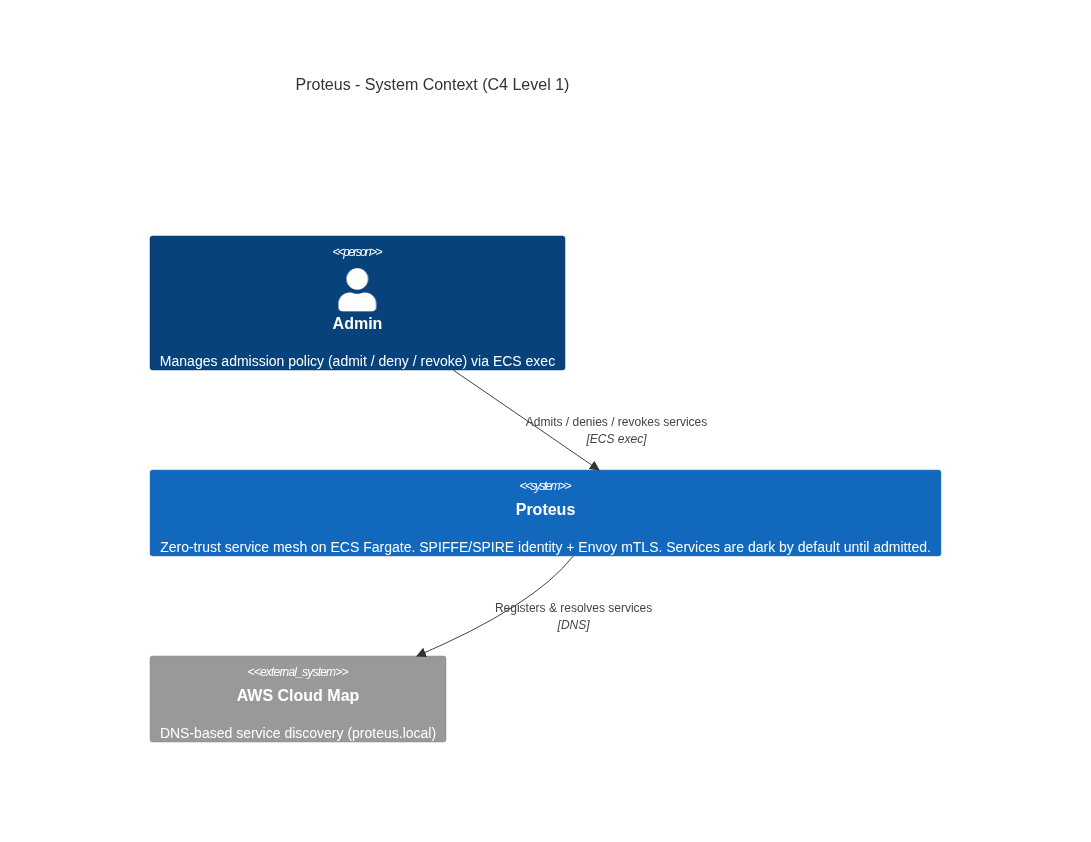
The goal was very clear: implement a mTLS solution for ECS, a poor’s version of zero trust.
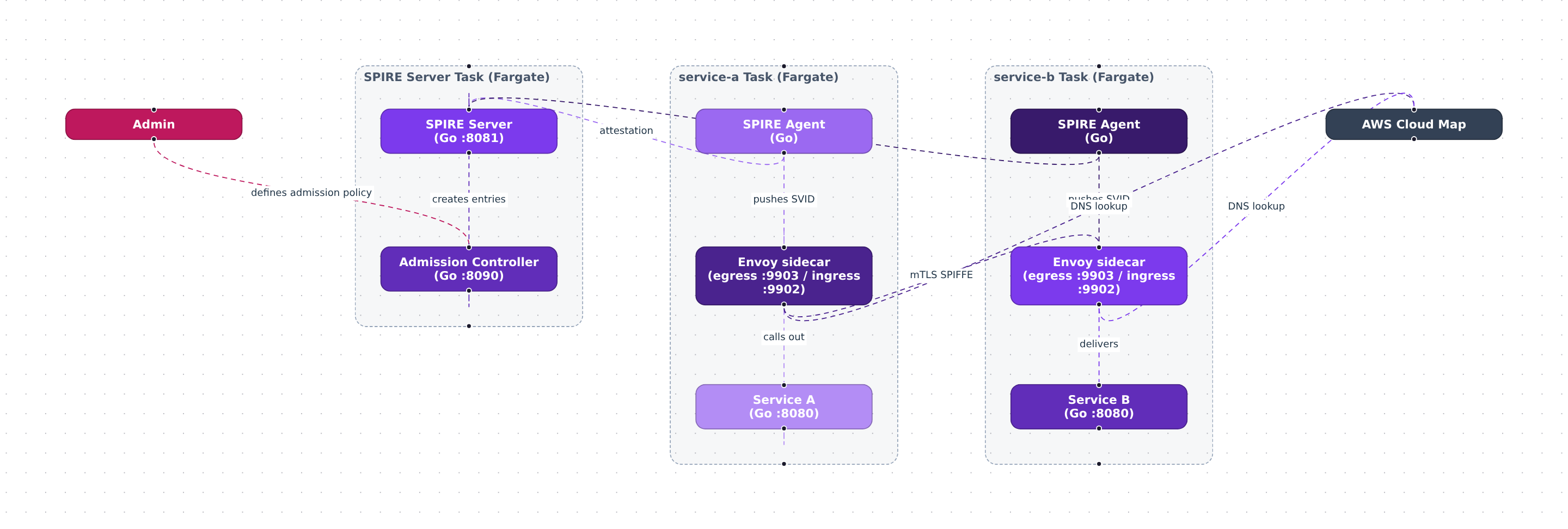
We create the architecture using:
- SPIRE Server + Admission Controller to allow/deny regiser in a service discovery
- SPIRE-Agent + Envoy sidecar to provide mTLS
- envoy sidecar to provide mTLS between services
- a custom
proteus_ecs node attestor (two plugin halves: agent-side gathers the task claim, server-side verifies it against the ECS API) — because Fargate has no EC2 host for the usual aws_iid attestor
We have configured the envoy to go from service-a to service-b using mtls, for this goal we configured the envoy to use SDS (Secret Discovery Service) to get the SVIDs from SPIRE-Agent, and we configured the SPIRE-Agent to get the SVIDs from SPIRE-Server.
The admission controller is used to allow/deny the registration of the service in the service discovery, this is a very important step to avoid that a malicious service can register in the service discovery and get access to the other services.
Architecture
Identity is established in two layers: first SPIRE decides which task it trusts (node attestation), then the admission controller decides which service identity that task is allowed to get (workload attestation).
Node attestation — proving the ECS task
On Fargate there is no EC2 instance, so the usual aws_iid node attestor doesn’t apply. I wrote a small custom node attestor, proteus_ecs — and like every SPIRE node attestor it comes in two halves: an agent-side plugin that gathers and sends the claim, and a server-side plugin that verifies it and decides whether to issue the node SVID. This runs automatically when the SPIRE Agent starts — SPIRE invokes the plugin as part of the agent’s boot handshake; nothing triggers it manually. The agent side reads the task metadata endpoint and forwards the task ARN, cluster and family:
metadataURI := os.Getenv("ECS_CONTAINER_METADATA_URI_V4")
body, _ := httpGet(metadataURI + "/task")   // TaskARN, Cluster, Family
The important part is on the server side: it never trusts the payload blindly. It calls the ECS API to confirm the task and checks the task’s IAM role against an allow-list:
taskInfo, _ := describeTask(ctx, region, cluster, payload.TaskARN) // ECS DescribeTasks
if !isRoleAllowed(taskInfo.TaskRoleARN) {
    return status.Error(codes.PermissionDenied, "task role not allowed")
}
// → spiffe://proteus.local/agent/ecs/<task-id>
//   selectors: ecs:cluster:*, ecs:family:*, ecs:task-role:*
So a task can claim an ARN, but the server verifies it out-of-band via DescribeTasks and only accepts pre-approved IAM roles.
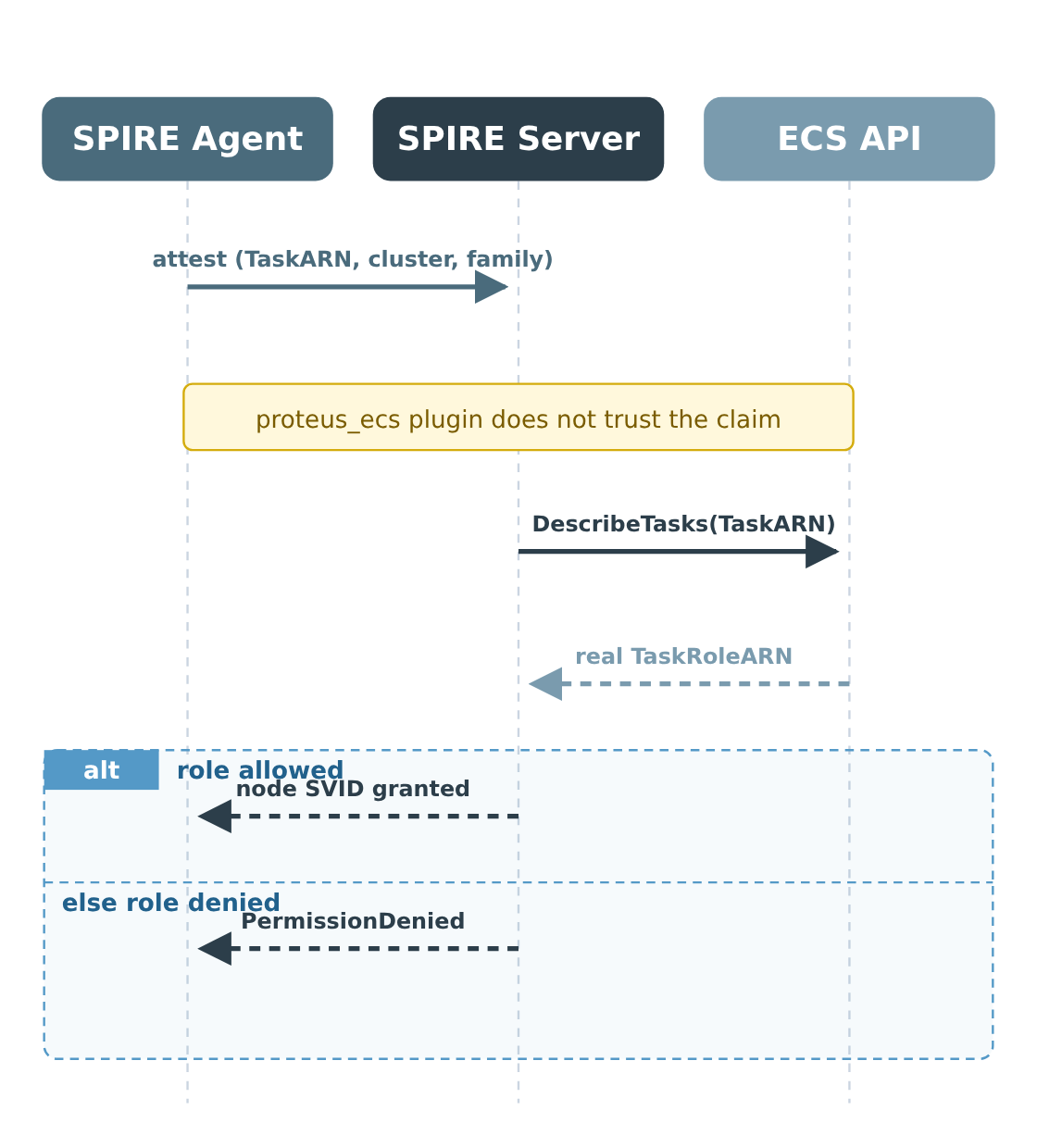
How to read it: the SPIRE Agent only claims an identity (it forwards the task ARN it read from metadata). The SPIRE Server is the trust anchor — it calls the ECS API (DescribeTasks) to confirm the task really exists and to fetch its IAM role, then checks that role against an allow-list. Only if the role passes does it mint the node SVID. This is why a compromised task can’t forge an identity: the proof comes from AWS, not from the agent’s own claim.
Workload attestation + admission — proving the service
Node attestation says which task; the admission controller says which service identity that task may hold. On POST /admit it creates a SPIRE registration entry via the Entry API:
spiffeID  := "spiffe://" + trustDomain + "/" + serviceName // e.g. .../service-a
selectors := []string{"unix:uid:1000"}
entryID, _ := spire.CreateEntry(ctx, parentID, spiffeID, selectors)
log.Printf("ADMITTED: service=%s spire_entry=%s", serviceName, entryID)
Until that entry exists, the agent has nothing to match and SDS returns workload is not authorized — this is the deny-by-default behavior the test below demonstrates. (The workload selector here is a coarse unix:uid:1000; tighter selectors are a natural next step.)
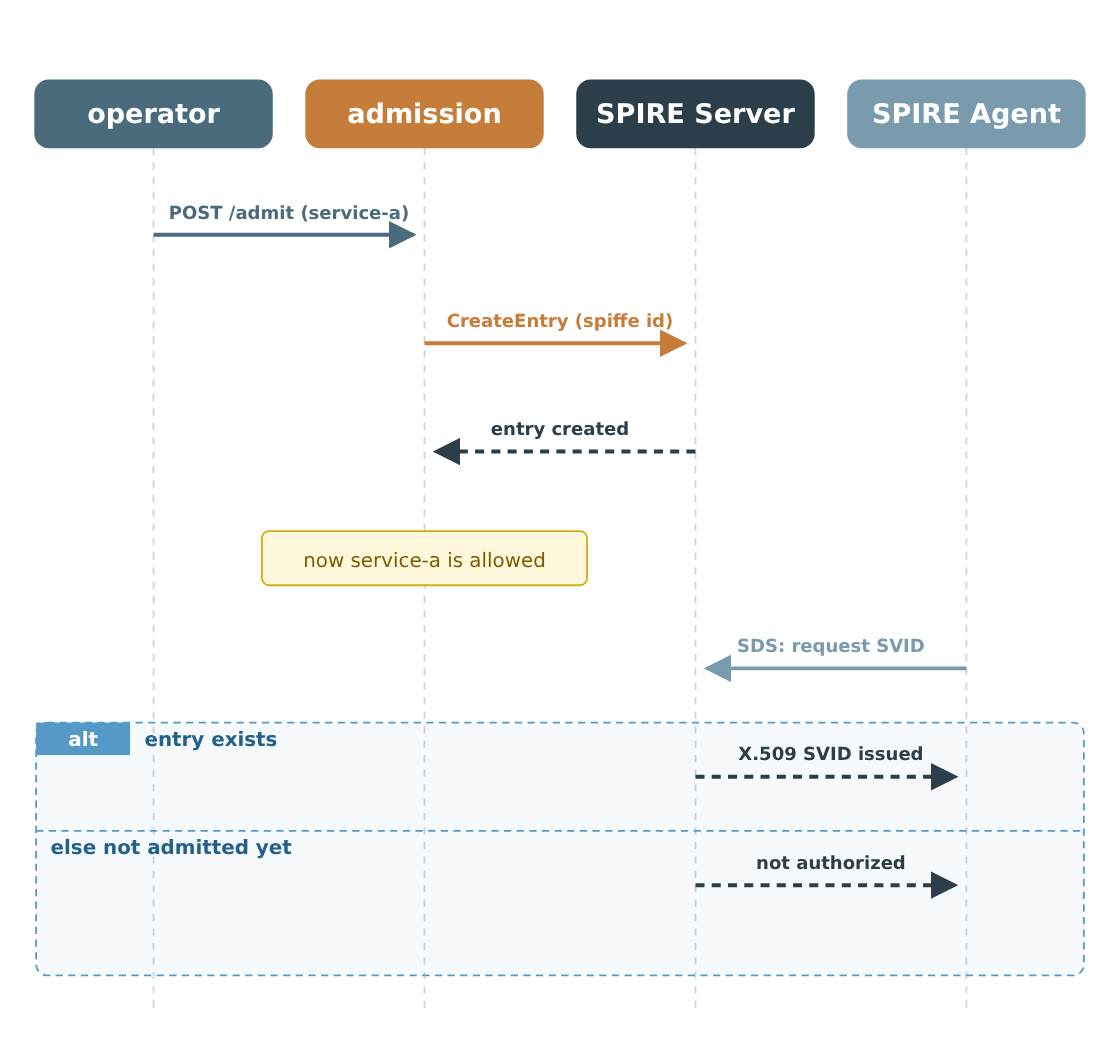
How the two layers relate. The proteus_ecs plugin and the admission controller answer two different questions, and a workload only gets a usable identity when both pass:
proteus_ecs plugin (node attestation) — is this really the ECS task it claims to be? Its server-side half calls the ECS API (DescribeTasks) to verify the task and its IAM role, then issues a node SVID (spiffe://proteus.local/agent/ecs/<task-id>). Trust comes from AWS, not from the workload’s own claim.- Admission controller (workload attestation) — is this task allowed to hold this service identity? On
POST /admit it creates a registration entry whose parentID is exactly that node SVID. That parent-child link is the seam: the controller can only grant a workload identity to a node the plugin already vouched for.
How the entry finds its agent. The CreateEntry call carries three fields that matter here:
CreateEntry(ctx, parentID, spiffeID, selectors)
// parentID  = spiffe://proteus.local/agent/ecs/<task-id>  ← the agent's node SVID
// spiffeID  = spiffe://proteus.local/service-a            ← the workload identity
// selectors = [unix:uid:1000]                             ← which process on that node
When Envoy later asks its local agent for service-a’s SVID over SDS, the SPIRE Server decides whether to issue it by matching two things at once:
parentID — is the requesting agent’s node SVID equal to the entry’s parentID? This binds the entry to one specific agent. service-a’s entry can only ever be served by the agent whose node SVID is spiffe://proteus.local/agent/ecs/<task-id> — i.e. the agent inside service-a’s own task. No other task’s agent matches.selectors — does the calling workload satisfy the selectors (unix:uid:1000)? This narrows it to the right process within that node.
Only when both match does the Server mint and stream the SVID. This is the security property: even if an attacker knew service-a’s SPIFFE ID, they couldn’t obtain its SVID from a different task, because their agent’s node identity wouldn’t equal the entry’s parentID. And it’s why node attestation must run first — without a node SVID there is no parentID to point the entry at.
So the plugin establishes infrastructure trust (a genuine ECS task with an approved role); the admission controller layers application policy on top (this task may be service-a). Neither alone is enough — the SVID is minted only when the verified node has an admitted entry to match.
All three control-plane hops run over gRPC: the attestor plugin (streaming RPC), the admission controller’s CreateEntry (SPIRE Entry API), and Envoy’s SDS (gRPC/HTTP2) — the SPIRE-local ones over a Unix socket.
Testing the architecture
The setup is intentionally minimal: two ECS services, service-a (the caller) and service-b (the callee), each with an Envoy sidecar and a co-located SPIRE Agent. service-a calls service-b over mTLS on /api/data. Both proxies fetch their identities from SPIRE via SDS.
The test walks through a dark → admit → live progression, proving that no workload receives an identity until it has been explicitly admitted.
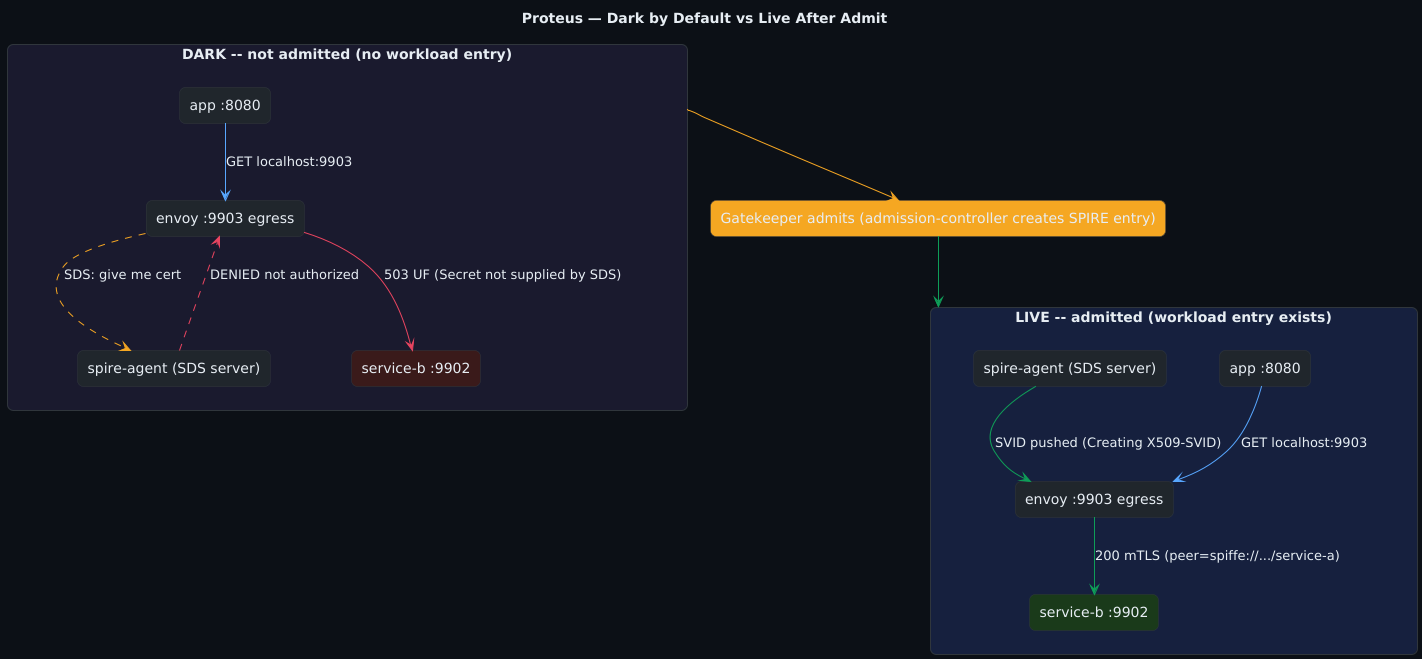
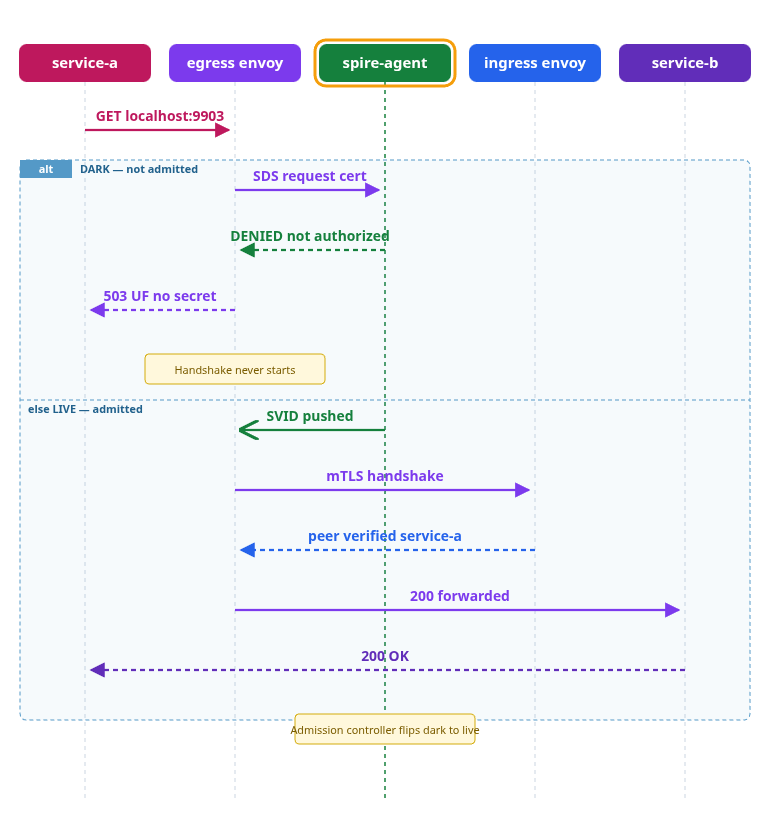
The same story as a sequence: in the dark branch Envoy’s SDS request is denied and the call fails with 503 UF; in the live branch — after the admission controller creates the SPIRE entry — the SVID is pushed and the mTLS call to service-b succeeds.
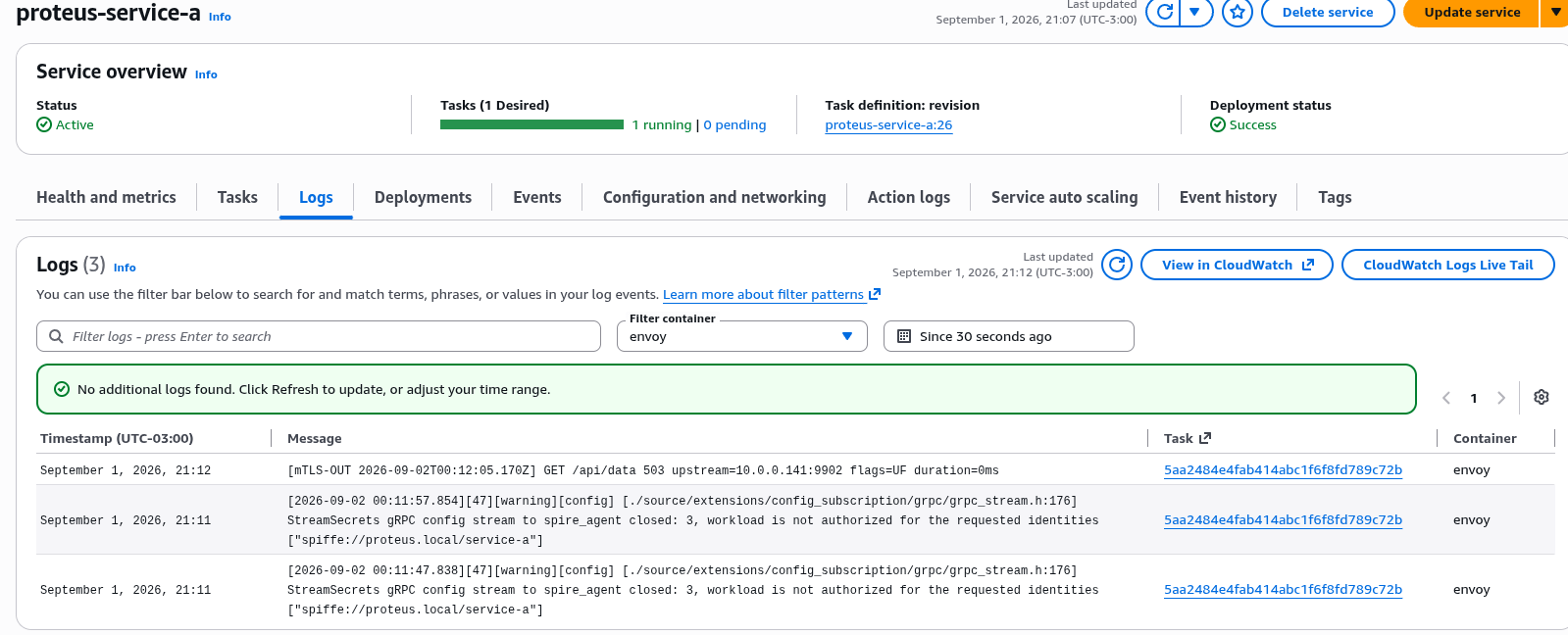
Step 1 — Dark state: no workload is admitted yet
Before any admission, Envoy asks SPIRE for an SVID and is rejected. The Envoy log on service-a shows the request failing with 503 flags=UF and, underneath, the SDS stream being closed:
workload is not authorized for the requested identities ["spiffe://proteus.local/service-a"]
On the service-b side, the SPIRE Agent reports the same thing from its own perspective — an SDS StreamSecrets request for spiffe://proteus.local/service-b fails with InvalidArgument: workload is not authorized:
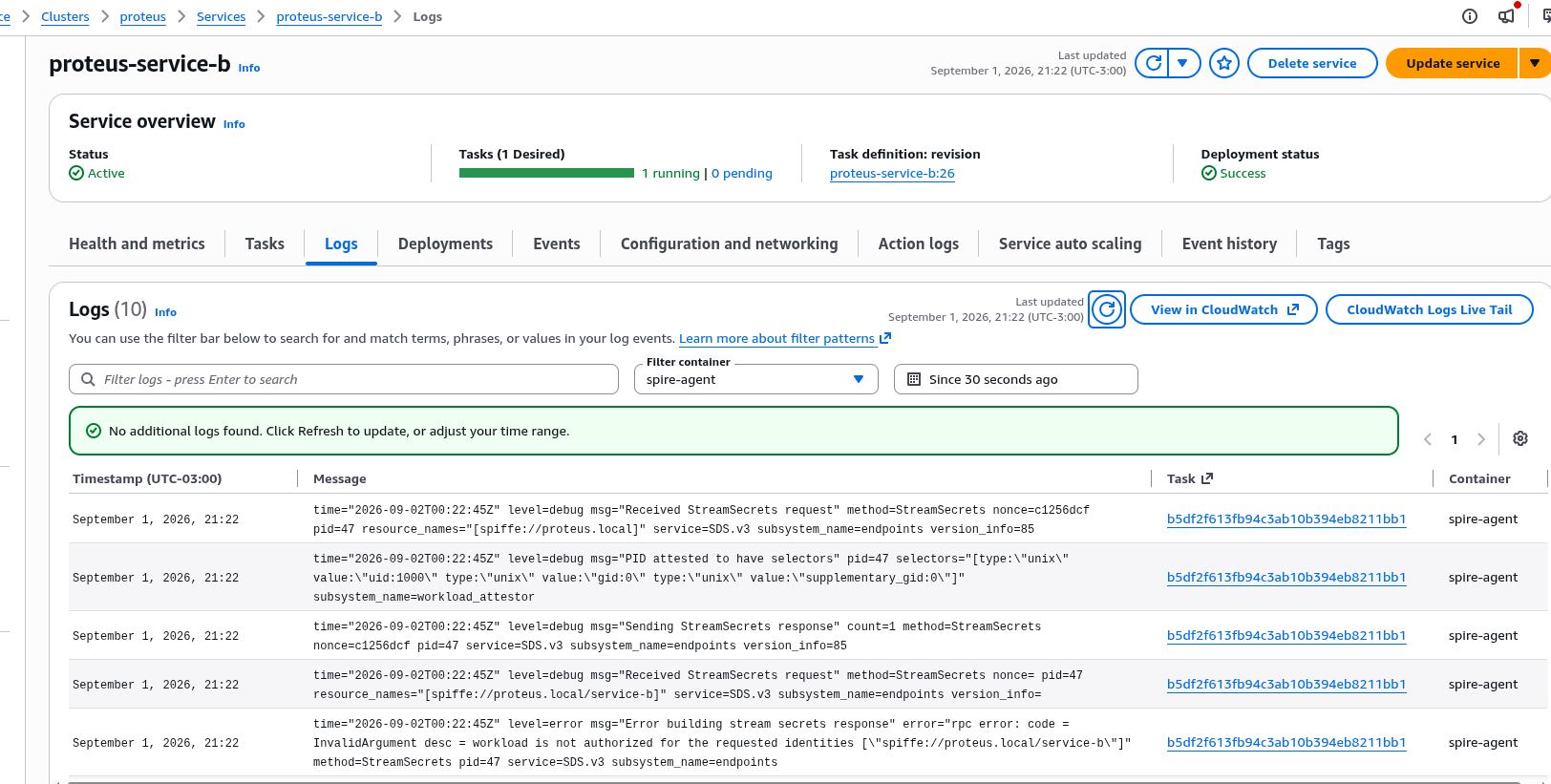
This is the whole point of the design: identity is deny-by-default.
What these logs actually prove. The workload is not authorized errors are a workload attestation failure — there’s no registration entry matching the requested SPIFFE ID yet. They are not node attestation. In fact, for the agent to reach this point it must have already node-attested successfully at startup (otherwise it couldn’t talk to the Server at all). Node attestation happens first, almost immediately when the task boots; it just isn’t what these dark-state screenshots capture. To see it directly you’d look at the agent/server startup logs where the node SVID (spiffe://proteus.local/agent/ecs/<task-id>) is issued.
Step 2 — Admit service-a
The Admission Controller is what flips a workload from dark to allowed. Once it approves service-a, it logs the admission and the SPIRE registration entry it created:
ADMITTED: microvm=service-a-task service=service-a spire_entry=6f842eda-9f2b-4f68-9bb8-ed514ec07937
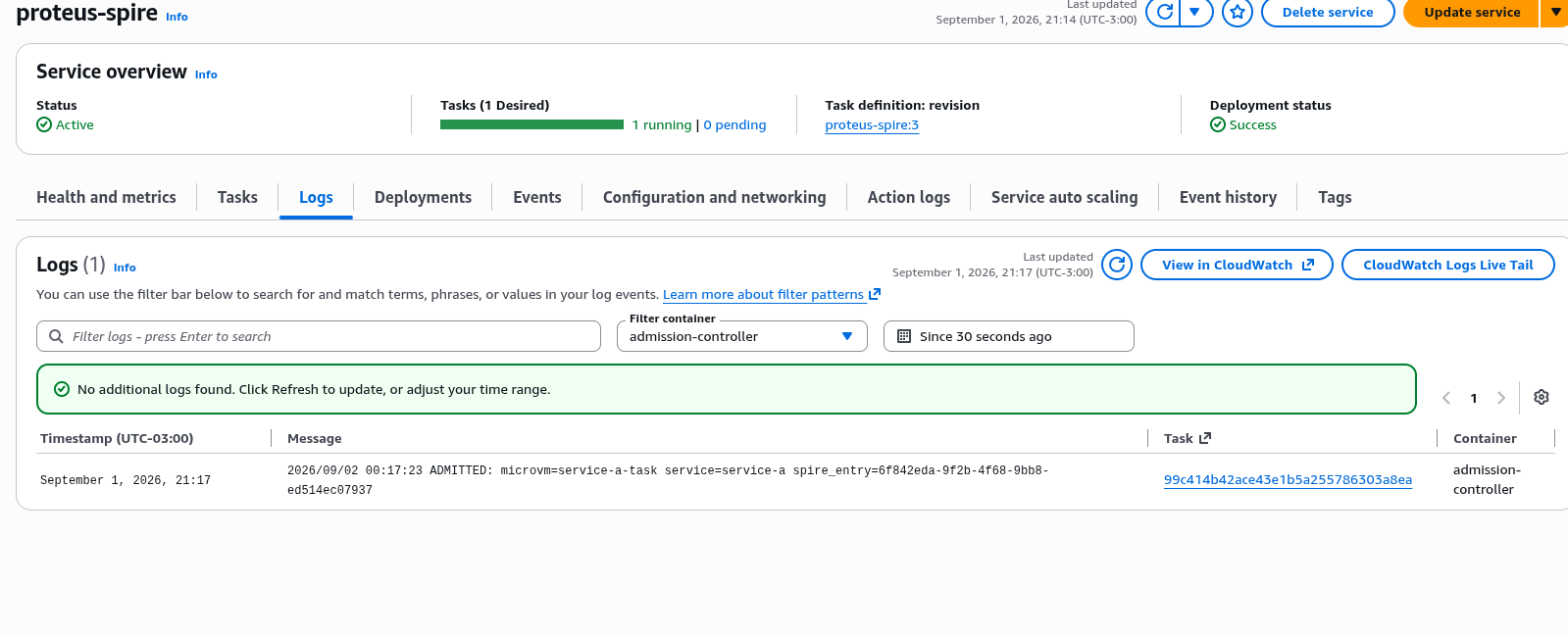
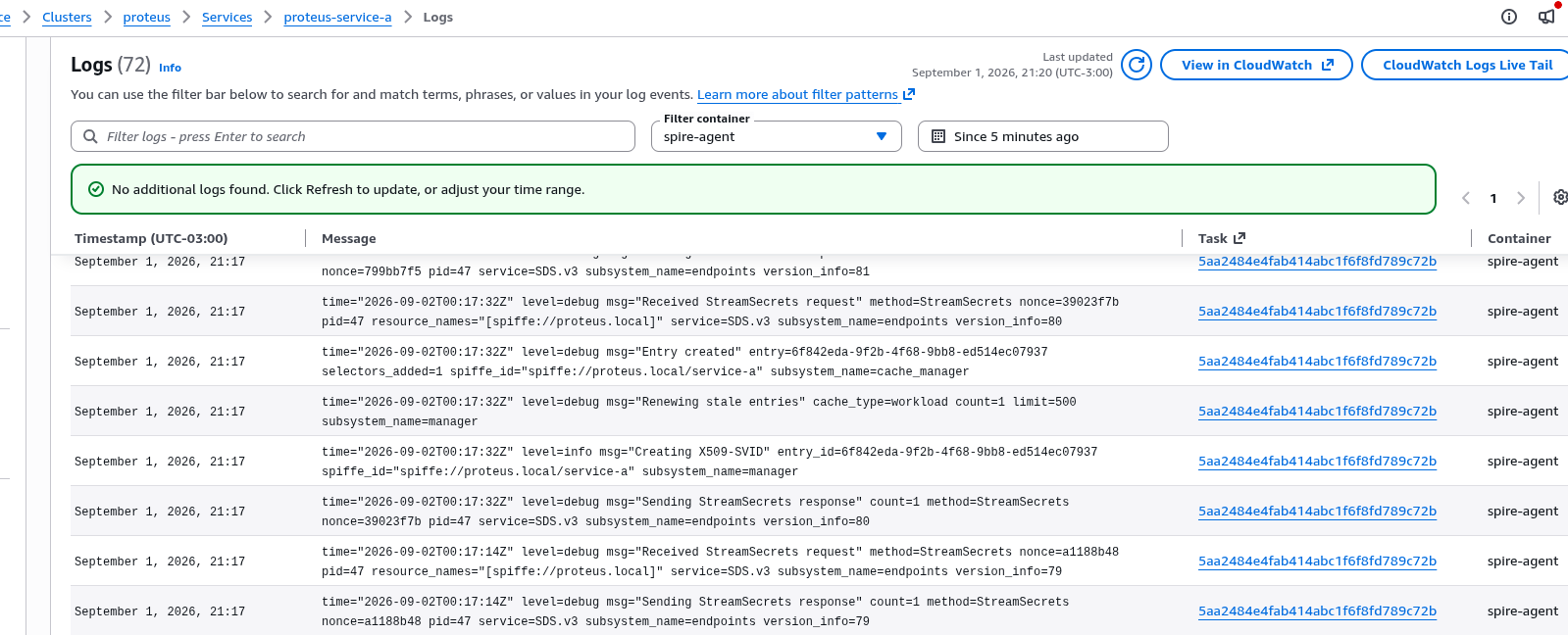
Step 3 — service-a receives its SVID
With the entry in place, the SPIRE Agent on service-a creates the workload entry, mints the X.509 SVID, and streams it to Envoy over SDS:
Entry created ... spiffe_id="spiffe://proteus.local/service-a" → Creating X509-SVID → Sending StreamSecrets response
Step 4 — Admit service-b and issue its SVID
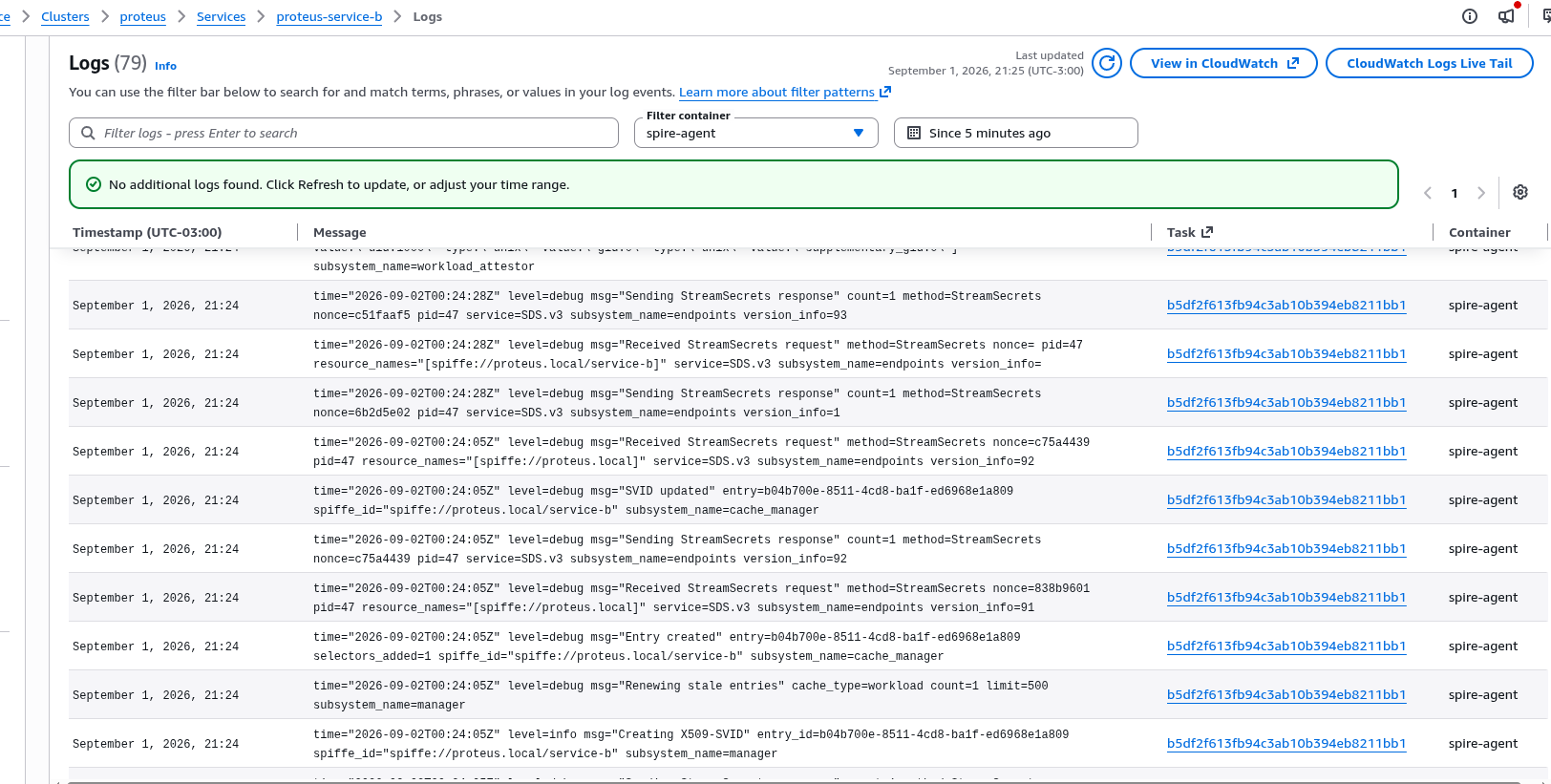
The same flow repeats for service-b. After it’s admitted, its SPIRE Agent creates the entry, updates the SVID, and serves it to Envoy:
Entry created ... spiffe://proteus.local/service-b → Creating X509-SVID → SVID updated
Step 5 — Live mTLS call succeeds
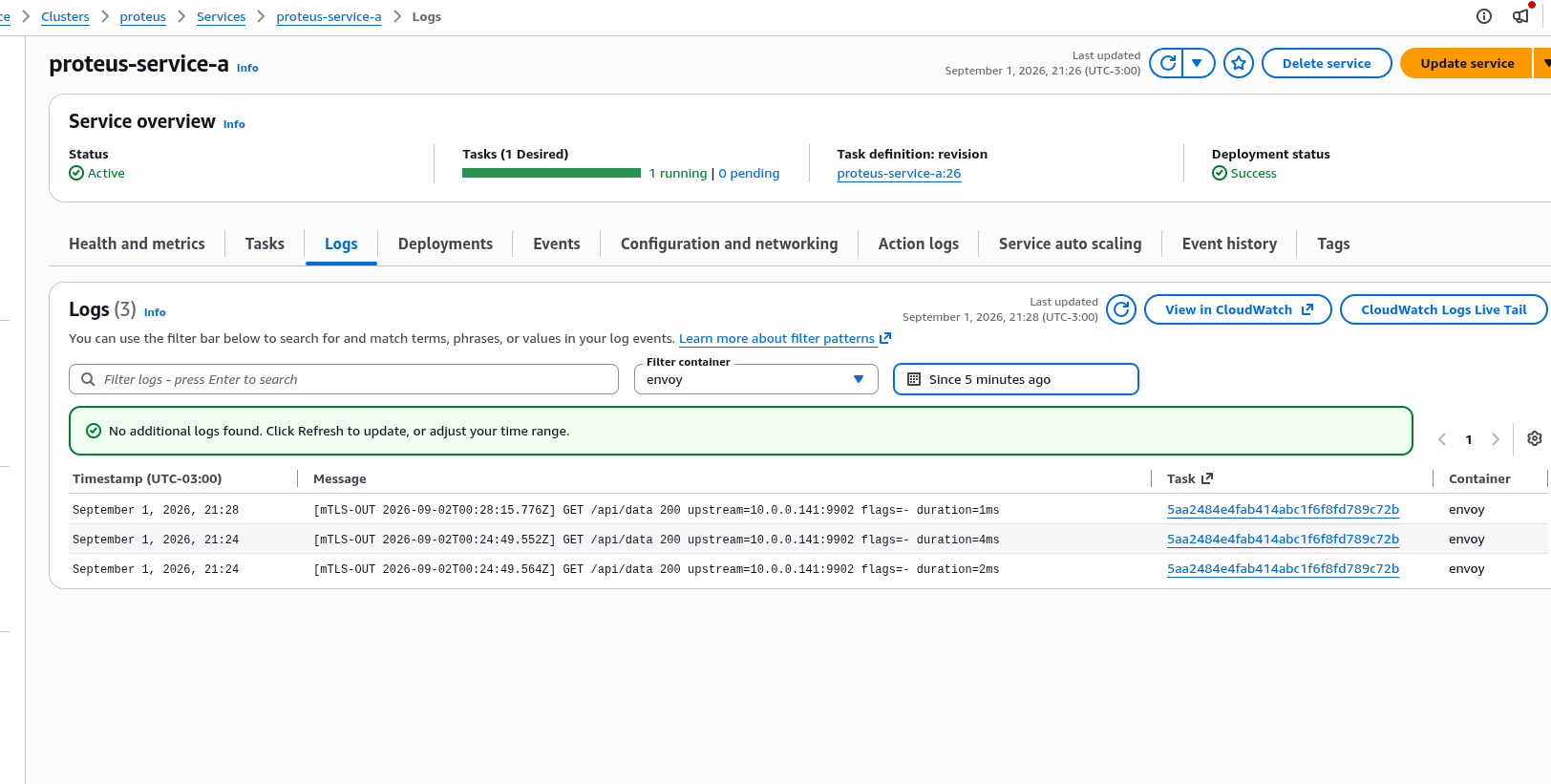
With both workloads holding valid SVIDs, the mTLS call goes through end to end.
On service-a, Envoy logs the outbound call succeeding:
[mTLS-OUT] GET /api/data 200 upstream=10.0.0.141:9902
On service-b, Envoy logs the inbound call and — crucially — the verified peer identity from the client certificate:
[mTLS-IN] GET /api/data 200 peer=spiffe://proteus.local/service-a
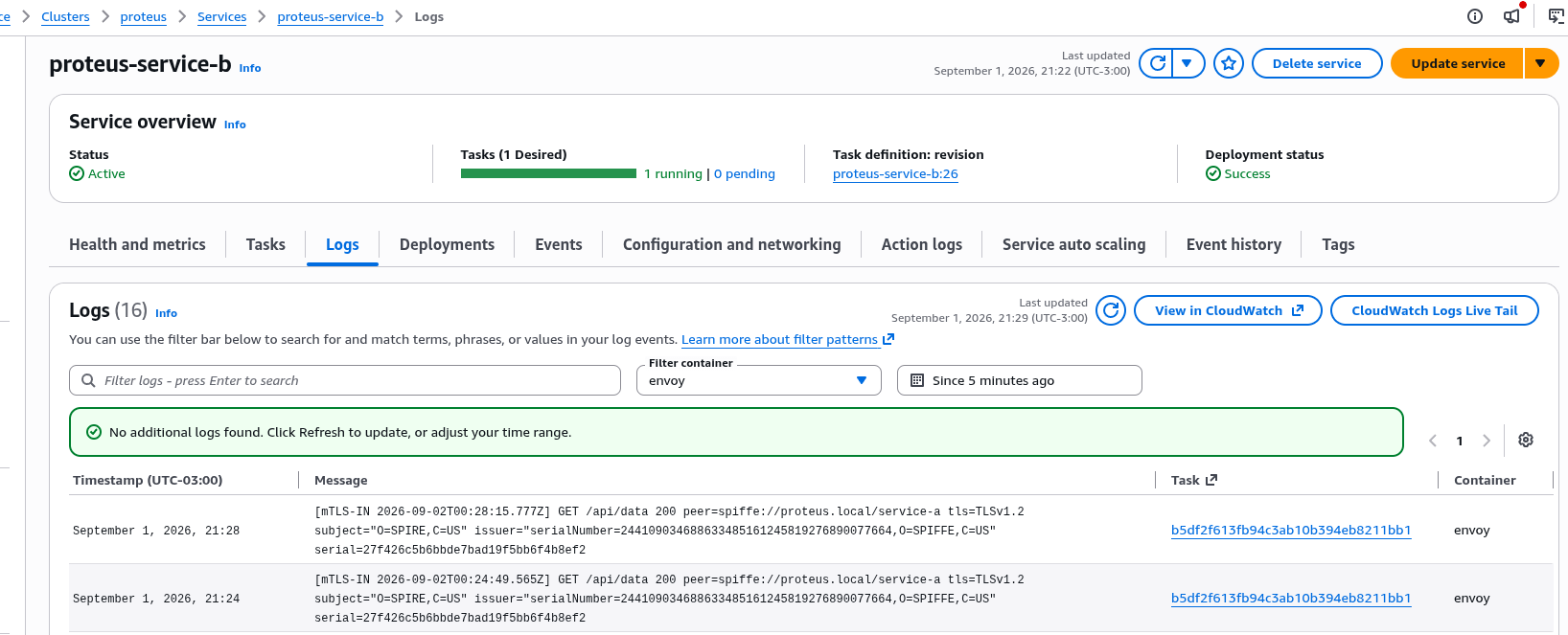
The peer=spiffe://proteus.local/service-a field is the payoff: service-b didn’t just accept a TLS connection, it cryptographically verified who was calling — no shared secret, no static cert, identity issued and rotated by SPIRE.
Conclusion
This hands-on project showed me the value of a control plane like Istio. The key lesson: communication should only be allowed between the listeners explicitly defined in each Envoy’s configuration. The hard part is doing that dynamically — when you launch many services, something has to create and update the Envoy configuration every time a new service joins. That “something” is exactly the job of a control plane, or of a purpose-built component that reconciles Envoy config as the service topology changes. Building it by hand made that responsibility concrete in a way that using Istio never did.
The piece I wasn’t familiar with going in was the port hop. The app never speaks mTLS or even touches the network directly — it makes a plain HTTP call to its own sidecar on localhost:9903 (the egress listener), and Envoy transparently negotiates mTLS to the peer’s :9902 ingress listener. So “the app calls localhost and mutual TLS just happens” is the mental model that took me a while to internalize. The trust boundary stops being where a service is (an IP or security group) and becomes who it is — service-b accepts the call because it cryptographically verified peer=spiffe://proteus.local/service-a, not because of a network rule.
Next steps I’d tackle: tighter workload selectors than the coarse unix:uid:1000, an automated admission trigger instead of a manual POST /admit, and a comparison against AWS App Mesh’s native mTLS to see what the from-scratch approach buys versus the managed path.
Llevo un tiempo estudiando Envoy porque, aunque quedé muy satisfecho con Istio, quería entender cómo funciona por debajo.
El objetivo era claro: implementar una solución de mTLS para ECS, una versión “casera” de zero trust.
Construimos la arquitectura usando:
- SPIRE Server + Admission Controller para permitir/denegar el registro en el service discovery
- SPIRE-Agent + sidecar Envoy para proveer mTLS entre servicios
- un verificador de nodo propio
proteus_ecs (dos mitades de plugin: el lado del agente reúne la afirmación de la tarea, el lado del servidor la verifica contra la API de ECS) — porque Fargate no tiene host EC2 para el verificador aws_iid habitual
Configuramos Envoy para ir de service-a a service-b usando mTLS; para ello configuramos Envoy para usar SDS (Secret Discovery Service) y obtener los SVIDs desde el SPIRE-Agent, y configuramos el SPIRE-Agent para obtener los SVIDs desde el SPIRE-Server.
El Admission Controller se usa para permitir/denegar el registro del servicio en el service discovery. Este paso es muy importante para evitar que un servicio malicioso se registre y obtenga acceso a los demás servicios.
Arquitectura
La identidad se establece en dos capas: primero SPIRE decide en qué tarea confía (verificación de nodo) y luego el admission controller decide qué identidad de servicio puede obtener esa tarea (verificación de workload).
Verificación de nodo — probando la tarea ECS
En Fargate no hay una instancia EC2, así que el verificador de nodo habitual aws_iid no aplica. Escribí un verificador de nodo propio, proteus_ecs — y como todo verificador de nodo de SPIRE viene en dos mitades: un plugin del lado del agente que reúne y envía la afirmación, y un plugin del lado del servidor que la verifica y decide si emite el SVID de nodo. Esto ocurre automáticamente cuando arranca el SPIRE Agent — SPIRE invoca el plugin como parte del handshake de arranque del agente; nada lo dispara manualmente. El lado del agente lee el endpoint de metadata de la tarea y reenvía el ARN de la tarea, el cluster y la family:
metadataURI := os.Getenv("ECS_CONTAINER_METADATA_URI_V4")
body, _ := httpGet(metadataURI + "/task")   // TaskARN, Cluster, Family
Lo importante está en el lado del servidor: nunca confía en el payload a ciegas. Llama a la API de ECS para confirmar la tarea y verifica el rol IAM de la tarea contra una allow-list:
taskInfo, _ := describeTask(ctx, region, cluster, payload.TaskARN) // ECS DescribeTasks
if !isRoleAllowed(taskInfo.TaskRoleARN) {
    return status.Error(codes.PermissionDenied, "task role not allowed")
}
// → spiffe://proteus.local/agent/ecs/<task-id>
//   selectors: ecs:cluster:*, ecs:family:*, ecs:task-role:*
Así, una tarea puede afirmar un ARN, pero el servidor lo verifica por fuera con DescribeTasks y solo acepta roles IAM previamente aprobados.
Cómo leerlo: el SPIRE Agent solo afirma una identidad (reenvía el ARN de la tarea que leyó de la metadata). El SPIRE Server es el ancla de confianza — llama a la API de ECS (DescribeTasks) para confirmar que la tarea existe y obtener su rol IAM, y luego verifica ese rol contra una lista permitida. Solo si el rol pasa, emite el SVID de nodo. Por eso una tarea comprometida no puede falsificar una identidad: la prueba viene de AWS, no de la afirmación del agente.
Verificación de workload + admisión — probando el servicio
La verificación de nodo dice qué tarea; el admission controller dice qué identidad de servicio puede tener esa tarea. En POST /admit crea una entrada de registro en SPIRE vía la Entry API:
spiffeID  := "spiffe://" + trustDomain + "/" + serviceName // p.ej. .../service-a
selectors := []string{"unix:uid:1000"}
entryID, _ := spire.CreateEntry(ctx, parentID, spiffeID, selectors)
log.Printf("ADMITTED: service=%s spire_entry=%s", serviceName, entryID)
Hasta que esa entrada existe, el agente no tiene nada que coincidir y SDS devuelve workload is not authorized — este es el comportamiento denegado-por-defecto que demuestra la prueba de abajo. (El selector de workload aquí es un unix:uid:1000 bastante amplio; selectores más estrictos son el siguiente paso natural.)
Cómo se relacionan las dos capas. El plugin proteus_ecs y el admission controller responden dos preguntas distintas, y un workload solo obtiene una identidad usable cuando ambas pasan:
- plugin
proteus_ecs (verificación de nodo) — ¿es realmente la tarea ECS que dice ser? Su lado servidor llama a la API de ECS (DescribeTasks) para verificar la tarea y su rol IAM, y luego emite un SVID de nodo (spiffe://proteus.local/agent/ecs/<task-id>). La confianza viene de AWS, no de la afirmación del propio workload.
- admission controller (verificación de workload) — ¿puede esa tarea tener esta identidad de servicio? En
POST /admit crea una entrada de registro cuyo parentID es exactamente ese SVID de nodo. Ese enlace padre-hijo es la costura: el controller solo puede otorgar una identidad de workload a un nodo que el plugin ya avaló.
Cómo la entrada encuentra a su agente. La llamada CreateEntry lleva tres campos que importan aquí:
CreateEntry(ctx, parentID, spiffeID, selectors)
// parentID  = spiffe://proteus.local/agent/ecs/<task-id>  ← el SVID de nodo del agente
// spiffeID  = spiffe://proteus.local/service-a            ← la identidad de workload
// selectors = [unix:uid:1000]                             ← qué proceso en ese nodo
Cuando después Envoy le pide a su agente local el SVID de service-a vía SDS, el SPIRE Server decide si emitirlo haciendo coincidir dos cosas a la vez:
parentID — ¿el SVID de nodo del agente solicitante es igual al parentID de la entrada? Esto ata la entrada a un agente específico. La entrada de service-a solo puede servirla el agente cuyo SVID de nodo es spiffe://proteus.local/agent/ecs/<task-id> — es decir, el agente dentro de la propia tarea de service-a. Ningún agente de otra tarea coincide.selectors — ¿el workload que llama cumple los selectores (unix:uid:1000)? Esto lo acota al proceso correcto dentro de ese nodo.
Solo cuando ambos coinciden el Server emite y transmite el SVID. Esta es la propiedad de seguridad: aunque un atacante conociera el SPIFFE ID de service-a, no podría obtener su SVID desde otra tarea, porque la identidad de nodo de su agente no sería igual al parentID de la entrada. Y por eso la verificación de nodo debe correr primero — sin un SVID de nodo no hay parentID al cual apuntar la entrada.
Así, el plugin establece la confianza de infraestructura (una tarea ECS genuina con un rol aprobado); el admission controller añade política de aplicación encima (esta tarea puede ser service-a). Ninguno basta por sí solo — el SVID se emite solo cuando el nodo verificado tiene una entrada admitida que coincida.
Los tres saltos del plano de control usan gRPC: el plugin verificador (RPC en streaming), el CreateEntry del admission controller (Entry API de SPIRE) y el SDS de Envoy (gRPC/HTTP2) — los locales a SPIRE sobre un socket Unix.
Probando la arquitectura
El montaje es intencionalmente mínimo: dos servicios ECS, service-a (el invocador) y service-b (el que recibe), cada uno con un sidecar Envoy y un SPIRE Agent co-ubicado. service-a llama a service-b sobre mTLS en /api/data. Ambos proxies obtienen sus identidades desde SPIRE vía SDS.
La prueba recorre una progresión oscuro → admitido → activo, demostrando que ningún workload recibe una identidad hasta que ha sido admitido explícitamente.
La misma historia como secuencia: en la rama oscura la petición SDS de Envoy es denegada y la llamada falla con 503 UF; en la rama activa — tras crear el admission controller la entrada en SPIRE — el SVID se entrega y la llamada mTLS a service-b tiene éxito.
Paso 1 — Estado oscuro: ningún workload admitido todavía
Antes de cualquier admisión, Envoy le pide un SVID a SPIRE y es rechazado. El log de Envoy en service-a muestra la petición fallando con 503 flags=UF y, debajo, el stream de SDS cerrándose:
workload is not authorized for the requested identities ["spiffe://proteus.local/service-a"]
Del lado de service-b, el SPIRE Agent reporta lo mismo desde su perspectiva — una petición SDS StreamSecrets para spiffe://proteus.local/service-b falla con InvalidArgument: workload is not authorized:
Este es justamente el punto del diseño: la identidad es denegada por defecto.
Qué prueban realmente estos logs. Los errores workload is not authorized son una falla de verificación de workload — todavía no existe una entrada de registro que coincida con el SPIFFE ID solicitado. No son verificación de nodo. De hecho, para que el agente llegue a este punto ya tuvo que haber hecho la verificación de nodo con éxito al arrancar (de lo contrario no podría ni hablar con el Server). La verificación de nodo ocurre primero, casi de inmediato al iniciar la tarea; simplemente no es lo que capturan estas capturas del estado oscuro. Para verla directamente mirarías los logs de arranque del agente/servidor donde se emite el SVID de nodo (spiffe://proteus.local/agent/ecs/<task-id>).
Paso 2 — Admitir service-a
El Admission Controller es lo que hace pasar a un workload de oscuro a permitido. Una vez que aprueba service-a, registra la admisión y la entrada de registro que creó en SPIRE:
ADMITTED: microvm=service-a-task service=service-a spire_entry=6f842eda-9f2b-4f68-9bb8-ed514ec07937
Paso 3 — service-a recibe su SVID
Con la entrada en su lugar, el SPIRE Agent en service-a crea la entrada del workload, emite el SVID X.509 y lo transmite a Envoy vía SDS:
Entry created ... spiffe_id="spiffe://proteus.local/service-a" → Creating X509-SVID → Sending StreamSecrets response
Paso 4 — Admitir service-b y emitir su SVID
El mismo flujo se repite para service-b. Tras ser admitido, su SPIRE Agent crea la entrada, actualiza el SVID y lo sirve a Envoy:
Entry created ... spiffe://proteus.local/service-b → Creating X509-SVID → SVID updated
Paso 5 — La llamada mTLS en vivo tiene éxito
Con ambos workloads teniendo SVIDs válidos, la llamada mTLS pasa de extremo a extremo.
En service-a, Envoy registra la llamada saliente exitosa:
[mTLS-OUT] GET /api/data 200 upstream=10.0.0.141:9902
En service-b, Envoy registra la llamada entrante y — lo más importante — la identidad del par verificada a partir del certificado de cliente:
[mTLS-IN] GET /api/data 200 peer=spiffe://proteus.local/service-a
El campo peer=spiffe://proteus.local/service-a es la recompensa: service-b no solo aceptó una conexión TLS, sino que verificó criptográficamente quién estaba llamando — sin secreto compartido, sin certificado estático, con identidad emitida y rotada por SPIRE.
Conclusión
Este proyecto práctico me mostró el valor de un control plane como Istio. La lección clave: la comunicación solo debería permitirse entre los listeners definidos explícitamente en la configuración de cada Envoy. La parte difícil es hacerlo de forma dinámica — cuando lanzas muchos servicios, algo tiene que crear y actualizar la configuración de Envoy cada vez que un nuevo servicio se une. Ese “algo” es justamente el trabajo de un control plane, o de un componente diseñado a medida que reconcilia la configuración de Envoy a medida que cambia la topología de servicios. Construirlo a mano hizo esa responsabilidad concreta de una forma que usar Istio nunca logró.
Lo que no me resultaba familiar al empezar fue el salto de puertos. La app nunca habla mTLS ni toca la red directamente — hace una llamada HTTP en claro a su propio sidecar en localhost:9903 (el listener de egress), y Envoy negocia de forma transparente mTLS hacia el listener de ingress :9902 del par. Así que “la app llama a localhost y el TLS mutuo simplemente ocurre” es el modelo mental que me costó un tiempo interiorizar. El límite de confianza deja de ser dónde está un servicio (una IP o un security group) y pasa a ser quién es — service-b acepta la llamada porque verificó criptográficamente peer=spiffe://proteus.local/service-a, no por una regla de red.
Próximos pasos que abordaría: selectores de workload más estrictos que el amplio unix:uid:1000, un disparador de admisión automático en lugar de un POST /admit manual, y una comparación con el mTLS nativo de AWS App Mesh para ver qué aporta el enfoque desde cero frente al camino gestionado.