Building a custom external authorization middleware with Go and Istio
Offloading Security to the Service Mesh
Modern architectures demand that we decouple security policies from business logic. Implementing authorization logic inside individual microservices creates code duplication and introduces potential security vulnerabilities if an endpoint is forgotten.
By leveraging Istio’s CUSTOM External Authorization (ext_authz), we can intercept incoming requests right at the Envoy sidecar proxy level and delegate validation to a dedicated, high-performance middleware service.
Request Flow Sequence
This step-by-step sequence diagram details exactly how requests are routed, validated by our middleware, and then forwarded downstream to execute business logic:
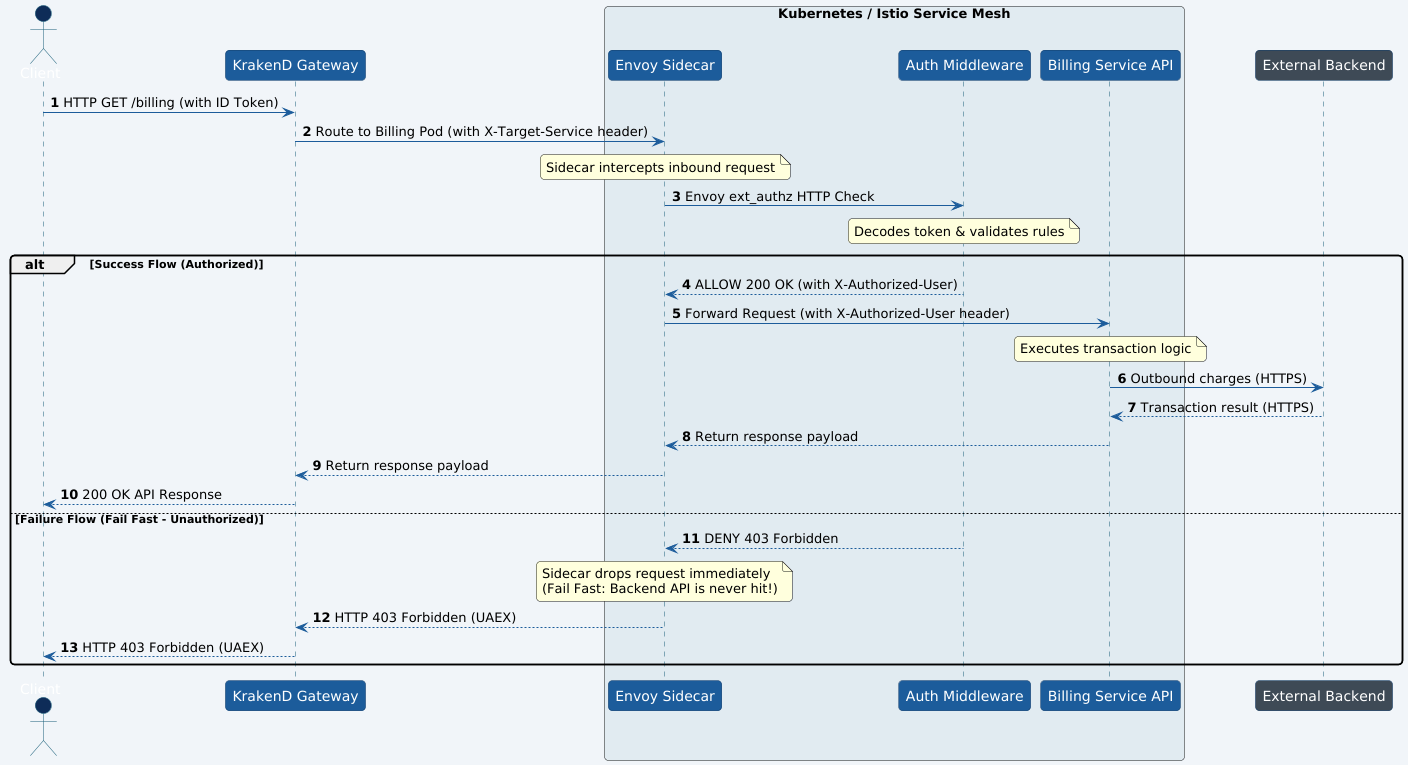
Token Scope Resolution with Istio ext_authz
We encountered a challenge when attempting to grant restricted access to a security principal in our infrastructure running on Kubernetes with Istio.
Specifically, we deployed an API Gateway at the ingress layer integrated with authentication via an external OIDC 2.0 Identity Provider (IDP). However, we could not restrict the token’s scope to a specific subset of services because the token we received was simply an ID_TOKEN. To resolve this scope limitation, we leveraged the Custom Authorization (External Authorizer) capability in Istio:
- Official Documentation: Istio Custom Authorization (ext_authz)
Registering the Custom External Authorizer in Istio
Before applying authorization policies, we must register our custom authorizer middleware inside the Istio MeshConfig configuration (usually in your istio-system configmap or via your IstioOperator):
meshConfig:
  extensionProviders:
  - name: "custom-auth-middleware"
    envoyExtAuthzHttp:
      service: "auth-middleware.auth-system.svc.cluster.local"
      port: "8080"
      path: "/check"
      includeRequestHeadersInCheck:
        - "authorization"
        - "x-target-service"
      headersToUpstreamOnAllow:
        - "x-authorized-user"
Applying the AuthorizationPolicy (AP)
Once registered, you activate the custom external authorizer for specific workloads using an AuthorizationPolicy with the CUSTOM action:
apiVersion: security.istio.io/v1beta1
kind: AuthorizationPolicy
metadata:
  name: ext-auth-policy
  namespace: billing-system
spec:
  selector:
    matchLabels:
      app: billing-service
  action: CUSTOM
  provider:
    name: "custom-auth-middleware"
  rules:
  - to:
    - operation:
        paths: ["/billing/*"]
Building the External Authorizer Middleware in Go
Go is an excellent choice for writing external authorizers due to its low memory footprint, rapid startup times, and rich networking capabilities.
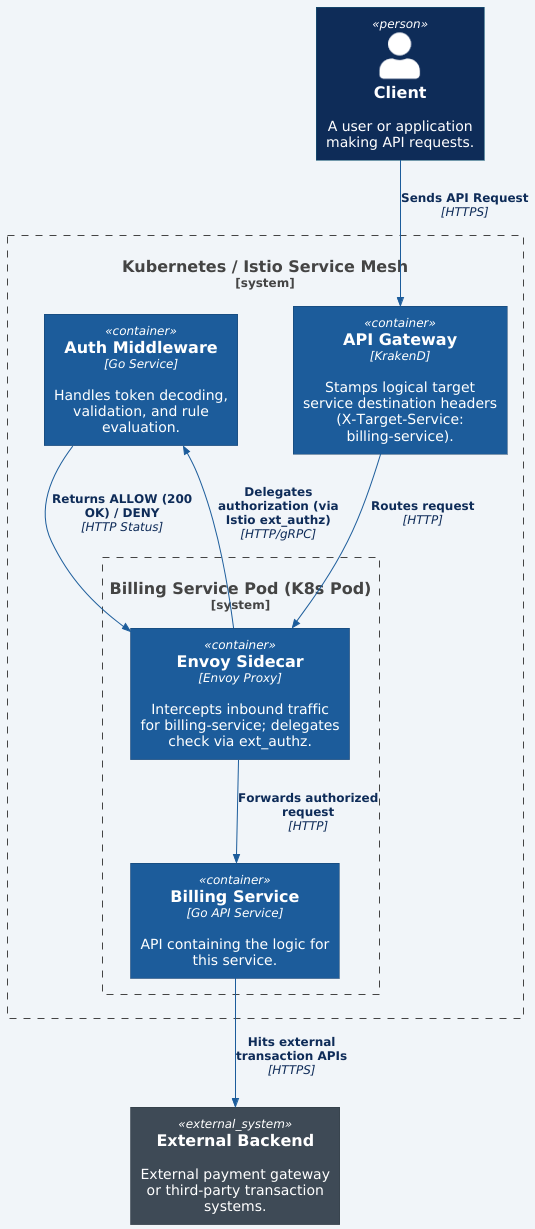
Below is a complete example of an HTTP-based authorizer middleware designed for Istio:
package main

import (
	"encoding/base64"
	"encoding/json"
	"log"
	"net/http"
	"strings"
)

type JWTPayload struct {
	Name   string `json:"name"`
	Msisdn string `json:"msisdn"`
}

type DenyResponse struct {
	Status  int    `json:"status"`
	Error   string `json:"error"`
	Message string `json:"message"`
	Reason  string `json:"reason"`
}

func respondDeny(w http.ResponseWriter, status int, reason string, msg string) {
	log.Printf("Action: DENY - Reason: %s | Message: %s", reason, msg)
	w.Header().Set("Content-Type", "application/json")
	w.Header().Set("X-Auth-Reason", reason)
	w.WriteHeader(status)

	resp := DenyResponse{
		Status:  status,
		Error:   http.StatusText(status),
		Message: msg,
		Reason:  reason,
	}
	_ = json.NewEncoder(w).Encode(resp)
}

func handleAuth(w http.ResponseWriter, r *http.Request) {
	// r.Host contains the original HTTP/2 :authority or Host header forwarded by Envoy!
	log.Printf("Received request from %s | Method: %s | Host/Service: %s | Path: %s", r.RemoteAddr, r.Method, r.Host, r.URL.Path)
	log.Println("--- Incoming Headers ---")
	for name, values := range r.Header {
		for _, value := range values {
			log.Printf("%s: %s", name, value)
		}
	}
	log.Println("------------------------")

	authHeader := r.Header.Get("Authorization")
	if authHeader == "" {
		respondDeny(w, http.StatusForbidden, "missing-authorization-header", "The Authorization header is required.")
		return
	}

	// 1. Parse MSISDN from request path (e.g. /v1/customer/123456789)
	pathParts := strings.Split(strings.Trim(r.URL.Path, "/"), "/")
	if len(pathParts) < 3 || pathParts[0] != "v1" || pathParts[1] != "customer" {
		respondDeny(w, http.StatusForbidden, "invalid-path-format", "The requested path format is invalid.")
		return
	}
	pathMsisdn := pathParts[2]

	// 2. Parse Fake JWT: Bearer <header>.<payload>.<signature>
	tokenParts := strings.Split(authHeader, " ")
	if len(tokenParts) != 2 || strings.ToLower(tokenParts[0]) != "bearer" {
		respondDeny(w, http.StatusForbidden, "invalid-authorization-format", "Authorization header must use Bearer scheme.")
		return
	}

	jwtParts := strings.Split(tokenParts[1], ".")
	var payloadSegment string
	if len(jwtParts) == 3 {
		payloadSegment = jwtParts[1]
	} else if len(jwtParts) == 1 {
		payloadSegment = jwtParts[0]
	} else {
		respondDeny(w, http.StatusForbidden, "invalid-jwt-structure", "The provided JWT token has an invalid structure.")
		return
	}

	// Base64 decode the payload
	if l := len(payloadSegment) % 4; l > 0 {
		payloadSegment += strings.Repeat("=", 4-l)
	}

	decodedBytes, err := base64.URLEncoding.DecodeString(payloadSegment)
	if err != nil {
		decodedBytes, err = base64.StdEncoding.DecodeString(payloadSegment)
	}

	if err != nil {
		respondDeny(w, http.StatusForbidden, "failed-to-decode-jwt", "Failed to base64-decode the token payload segment.")
		return
	}

	var payload JWTPayload
	if err := json.Unmarshal(decodedBytes, &payload); err != nil {
		respondDeny(w, http.StatusForbidden, "failed-to-parse-jwt-json", "Failed to parse JWT payload JSON.")
		return
	}

	log.Printf("Parsed JWT: Name=%s, TokenMSISDN=%s | Requested Path MSISDN: %s", payload.Name, payload.Msisdn, pathMsisdn)

	// 3. Match Token MSISDN against Path MSISDN
	if payload.Msisdn == pathMsisdn {
		log.Printf("Action: ALLOW - Token MSISDN matches Path MSISDN! User=%s", payload.Name)
		w.Header().Set("X-Auth-User", payload.Name)
		w.Header().Set("X-Auth-Email", strings.ToLower(payload.Name)+"@example.com")
		w.WriteHeader(http.StatusOK)
		w.Write([]byte("allowed"))
	} else {
		respondDeny(w, http.StatusForbidden, "path-msisdn-mismatch", "The token's MSISDN does not match the requested path's MSISDN.")
	}
}

func main() {
	http.HandleFunc("/", handleAuth)
	log.Println("Starting dummy external auth server on :8000...")
	if err := http.ListenAndServe(":8000", nil); err != nil {
		log.Fatalf("Server failed: %v", err)
	}
}
Real-World Kubernetes Pod Logs (A Tale of Two Containers)
Inside our billing-service Kubernetes Pod, we run two separate containers in a sidecar pattern. Here is exactly how their logs differ, showing that the proxy sidecar handles rejections before they can ever hit the downstream application container:
1. Custom Auth Middleware Logs (External Service)
2026/08/09 01:04:54 Received request from 127.0.0.6:54943 | Method: GET | Host/Service: httpbin:8000 | Path: /headers
2026/08/09 01:04:54 --- Incoming Headers ---
2026/08/09 01:04:54 Content-Length: 0
2026/08/09 01:04:54 X-Forwarded-Proto: https
2026/08/09 01:04:54 X-Request-Id: daa4fae4-c062-4f15-9ae1-da522e5a6ece
2026/08/09 01:04:54 X-Forwarded-Client-Cert: By=spiffe://cluster.local/ns/foo/sa/default;Hash=74f738d5be270b155a1ff5902fe0cc9a0d89fd10a6d1983c5f4c01a4f8f192a9;Subject="";URI=spiffe://cluster.local/ns/foo/sa/default
2026/08/09 01:04:54 ------------------------
2026/08/09 01:04:54 Action: DENY - Reason: missing-authorization-header | Message: The Authorization header is required.

2026/08/09 01:07:44 Received request from 127.0.0.6:57649 | Method: GET | Host/Service: dummy-svc-app:8080 | Path: /v1/customer/123456789
2026/08/09 01:07:44 --- Incoming Headers ---
2026/08/09 01:07:44 Content-Length: 0
2026/08/09 01:07:44 Authorization: Bearer eyJhbGciOiJIUzI1NiIsInR5cCI6IkpXVCJ9.eyJuYW1lIjoiQWxpY2UiLCJtc2lzZG4iOiIxMjM0NTY3ODkifQ==.signature
2026/08/09 01:07:44 X-Forwarded-Proto: https
2026/08/09 01:07:44 X-Request-Id: afb37c6d-ef75-4e9a-8096-2c7be9f9f384
2026/08/09 01:07:44 X-Forwarded-Client-Cert: By=spiffe://cluster.local/ns/foo/sa/default;Hash=74b7b906cb9435fcf73f37b08b7050cfa771105658b3a683faf0be0832eec256;Subject="";URI=spiffe://cluster.local/ns/foo/sa/default
2026/08/09 01:07:44 ------------------------
2026/08/09 01:07:44 Parsed JWT: Name=Alice, TokenMSISDN=123456789 | Requested Path MSISDN: 123456789
2026/08/09 01:07:44 Action: ALLOW - Token MSISDN matches Path MSISDN! User=Alice
2. Envoy Sidecar Proxy Logs (Container 1 inside Billing Pod)
[!NOTE] The Envoy Sidecar interceptor sees all requests. For the denied request, Envoy logs standard status code
403with the custom response flagUAEX, indicating rejection by the external authorizer without hitting the downstream server:
[2026-08-09T00:55:12.156Z] "GET /v1/customer/123456789 HTTP/1.1" 200 - via_upstream - "-" 0 634 21 12 "-" "curl/8.2.1" "8b8aedf5-e4e1-42af-a7e3-214c73b71d76" "dummy-svc-app:8080" "10.244.0.28:8080" inbound|8080|| 127.0.0.6:55597 10.244.0.28:8080 10.244.0.30:52152 outbound_.8080_._.dummy-svc-app.foo.svc.cluster.local default
[2026-08-09T00:56:18.465Z] "GET /v1/customer/123456789 HTTP/1.1" 403 UAEX ext_authz_denied - "-" 0 125 11 - "-" "curl/8.2.1" "78adb6f2-1fad-4e0c-a786-03def12899ae" "dummy-svc-app:8080" "-" inbound|8080|| - 10.244.0.28:8080 10.244.0.30:36340 outbound_.8080_._.dummy-svc-app.foo.svc.cluster.local default
[2026-08-09T00:56:21.195Z] "GET /v1/customer/3434234234 HTTP/1.1" 403 UAEX ext_authz_denied - "-" 0 142 1 - "-" "curl/8.2.1" "e0752295-01ae-4dae-9611-54656cb48ba1" "dummy-svc-app:8080" "-" inbound|8080|| - 10.244.0.28:8080 10.244.0.30:52152 outbound_.8080_._.dummy-svc-app.foo.svc.cluster.local default
3. Billing Service Logs (Container 2 inside Billing Pod)
[!IMPORTANT] Because Envoy terminated the unauthorized request at
22:42:15, absolutely no request was made to our application container! The Billing Service application logs only ever see successful traffic, remaining 100% clean of security noise:
2026/08/09 00:55:12 Received request for path: /v1/customer/123456789
2026/08/09 01:00:16 Received request for path: /v1/customer/123456789
# Note: The unauthorized request at 22:42:15 was blocked by Envoy and never reached this container!
Conclusion: Decentralized Enforcement with Centralized Logic
Offloading authorization validation to the service mesh layer represents a massive shift in how we secure distributed systems. By combining Istio’s Custom Authorization with a high-performance Go middleware, we achieve the best of both worlds:
- True Decoupling: Application containers remain completely oblivious to token schemas, encryption details, and policy rules, allowing developers to focus 100% on business functionality.
- Fail-Fast Security: Envoy drops unauthorized requests immediately at the pod perimeter. Security threats are neutralized before they can consume resources or generate telemetry noise inside your backend containers.
- High Performance: Executing policy evaluations locally via a lightweight sidecar keeps network latency at a bare minimum while maintaining centralized control.
Embracing mesh-level authorization is not just about keeping codebases clean—it’s about building a robust, auditable, and resilient cloud-native security posture.