Functional Programming with Java 21
This system architectural record is currently being refined.
I have been doing a lot of programming in F# lately and wanted to try to replicate that mindset in Java 21.
The Railway Pattern
We can model the Result<'T, 'E> type in F#, which consists of boxing two possible scenarios: Ok and Err.
In F#, we can model this as follows:
type Result<'T,'E> =
 | Ok of 'T
 | Err of 'E
The Result type is the key to the Railway Pattern, which is a way to model computations.
We can replicate this in Java 21 with the following:
sealed interface Result<T, E> {

    record Ok<T, E>(T value) implements Result<T, E> {}
    record Err<T, E>(E error) implements Result<T, E> {}
}
Here is a visual representation of how the Result container acts as a box holding either a success (Ok) or a failure (Err) track:
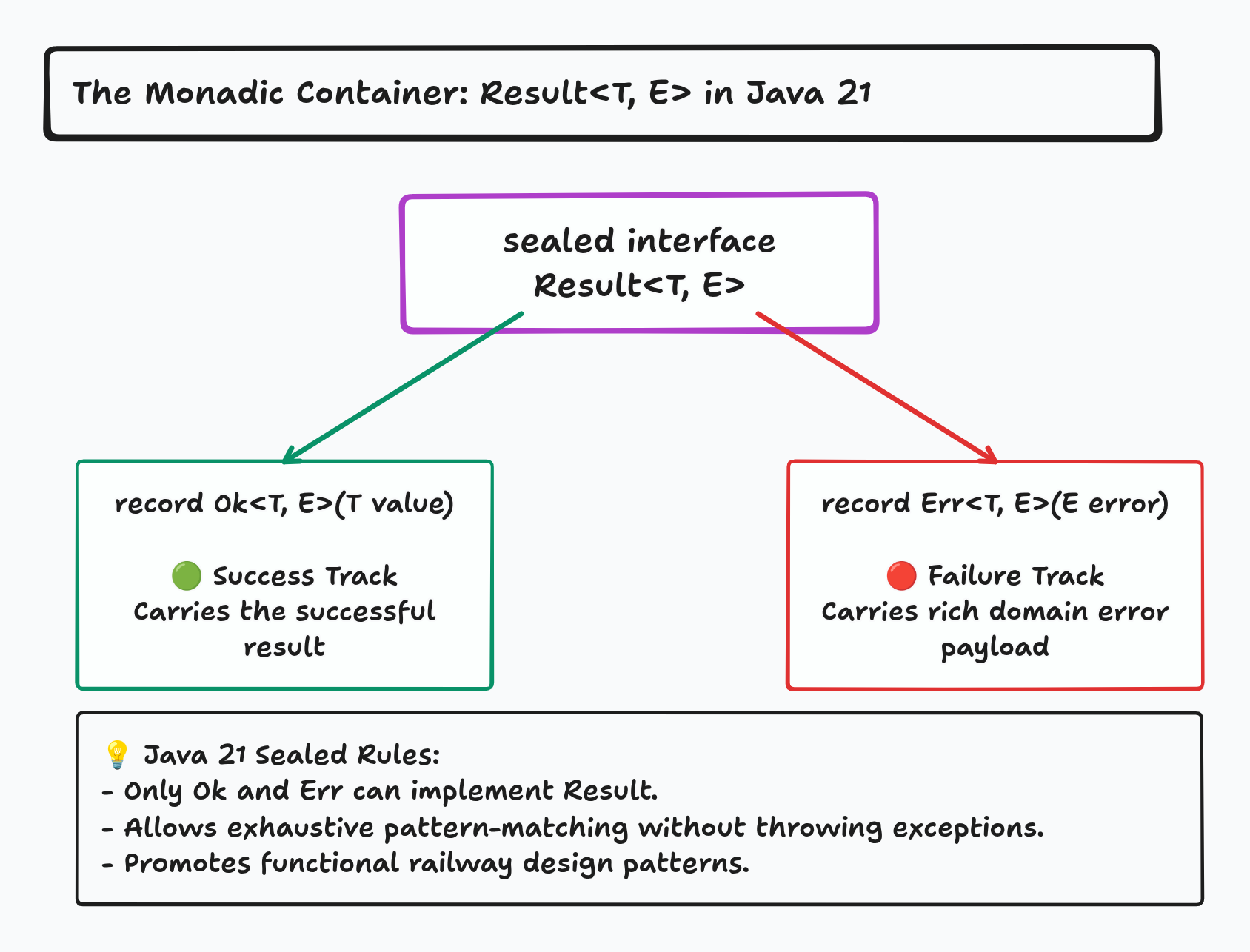
Representing this container as a sealed interface forces us to always handle and evaluate both Result cases exhaustively.
In addition to the Railway Pattern, we need to create a context for a specific use case. We will use the example of a LendingService for a bookstore.
If we want to isolate the possible outcomes of this specific use case, we can create a set of results for each scenario.
In Java 21, we can model this as follows:
interface LendingResult {
    record Success(BookLending lending) implements LendingResult {}
    record MemberNotFound(MemberId memberId) implements LendingResult {}
    record MemberHasOverdueBooks(MemberId memberId) implements LendingResult {}
    record BookItemNotAvailable(BookItemId bookItemId) implements LendingResult {}
}
Here, we define all the possible outcomes of the LendingService. We then need a way to compose our operations—for example: first validating the user, then finding the book, and finally processing the loan.
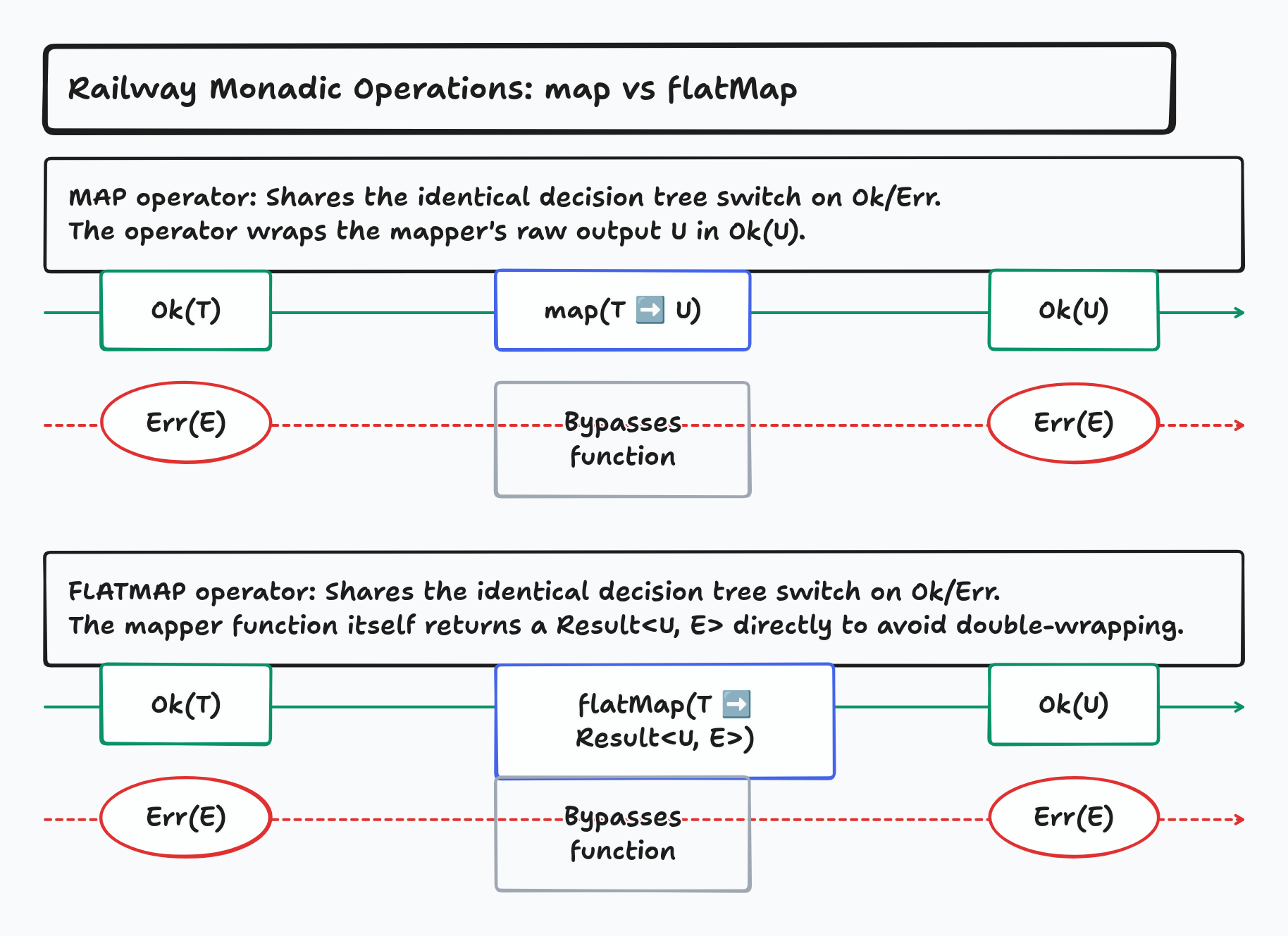
- flatMap: We use this to compose results. The difference from
mapis thatflatMaptakes a function that returns aResult<U, E>, rather than wrapping a raw value. - map: We use this to transform the success type of the result. It always wraps the returned value in a new
Okcontainer. - fold: We use this to resolve both possible outcomes into a single final type (in our scenario, we use it to map either side to a final
LendingResult). In functional programming, this is also called a catamorphism.
Here is a visual breakdown of how map and flatMap behave on our railway tracks:
We can implement flatMap, map, and fold directly in our Java 21 Result interface as follows:
sealed interface Result<T, E> {

    record Ok<T, E>(T value) implements Result<T, E> {}
    record Err<T, E>(E error) implements Result<T, E> {}

    default <U> Result<U, E> flatMap(Function<T, Result<U, E>> mapper) {
        return switch (this) {
            case Ok<T, E> ok -> mapper.apply(ok.value());
            case Err<T, E> err -> new Err<>(err.error());
        };
    }

    default <U> Result<U, E> map(Function<T, U> mapper) {
        return switch (this) {
            case Ok<T, E> ok -> new Ok<>(mapper.apply(ok.value()));
            case Err<T, E> err -> new Err<>(err.error());
        };
    }

    default <U> U fold(Function<T, U> onSuccess, Function<E, U> onFailure) {
        return switch (this) {
            case Ok<T, E> ok -> onSuccess.apply(ok.value());
            case Err<T, E> err -> onFailure.apply(err.error());
        };
    }
}
The most important part here is the signature: we need to operate on the right (success) side of the result and then apply the function that returns a new type.
💡 A Key Realization: Why do map and flatMap handle Err identically?
If you look closely at the Java implementation of both methods, you’ll notice a fascinating detail. The code block for handling an existing error is exactly identical in both:
case Err<T, E> err -> new Err<>(err.error());
If they do the exact same thing on errors, why do we need two different operators?
The distinction is not how they handle an existing error, but whether they can produce a new error from a success:
mapis a “1-Track” Operator (Infallible on Success):
- The function you pass (
Function<T, U>) returns a plain valueU. - It cannot fail.
- If
mapreceives anOk, it applies your function, and always wraps the result back inside anew Ok<>(...). You are guaranteed to stay on the green success track.
flatMapis a “2-Track” Operator (Fallible on Success):
- The function you pass (
Function<T, Result<U, E>>) returns anotherResult. - It can fail.
- Even if
flatMapreceives anOk, applying your function might return anErr<E>. This is how a pipeline step (like checkOverdue) switches your journey from the green track (Success) to the red track (Failure)!
So, while both simply let errors pass through unchanged, only flatMap has the power to shift a happy success over to the error railway track based on a business decision.
Wait, Why Not Use Optional?
A common question is: “Why not just use Java’s built-in Optional?”
While Optional is great for representing the absence of a value, it has a fatal flaw for business pipelines: it cannot carry an error payload. If an operation fails, Optional.empty() won’t tell you why (e.g., whether the member was not found, or if they had overdue books). Result<T, E> keeps errors as first-class citizens, preserving rich domain-specific error payloads.
Visualizing the Railway Flow
Here is how the request flows through our pipeline. You can see how each step transitions forward on success or branches down to its specific LendingResult outcome (our custom-tailored errors) on failure:
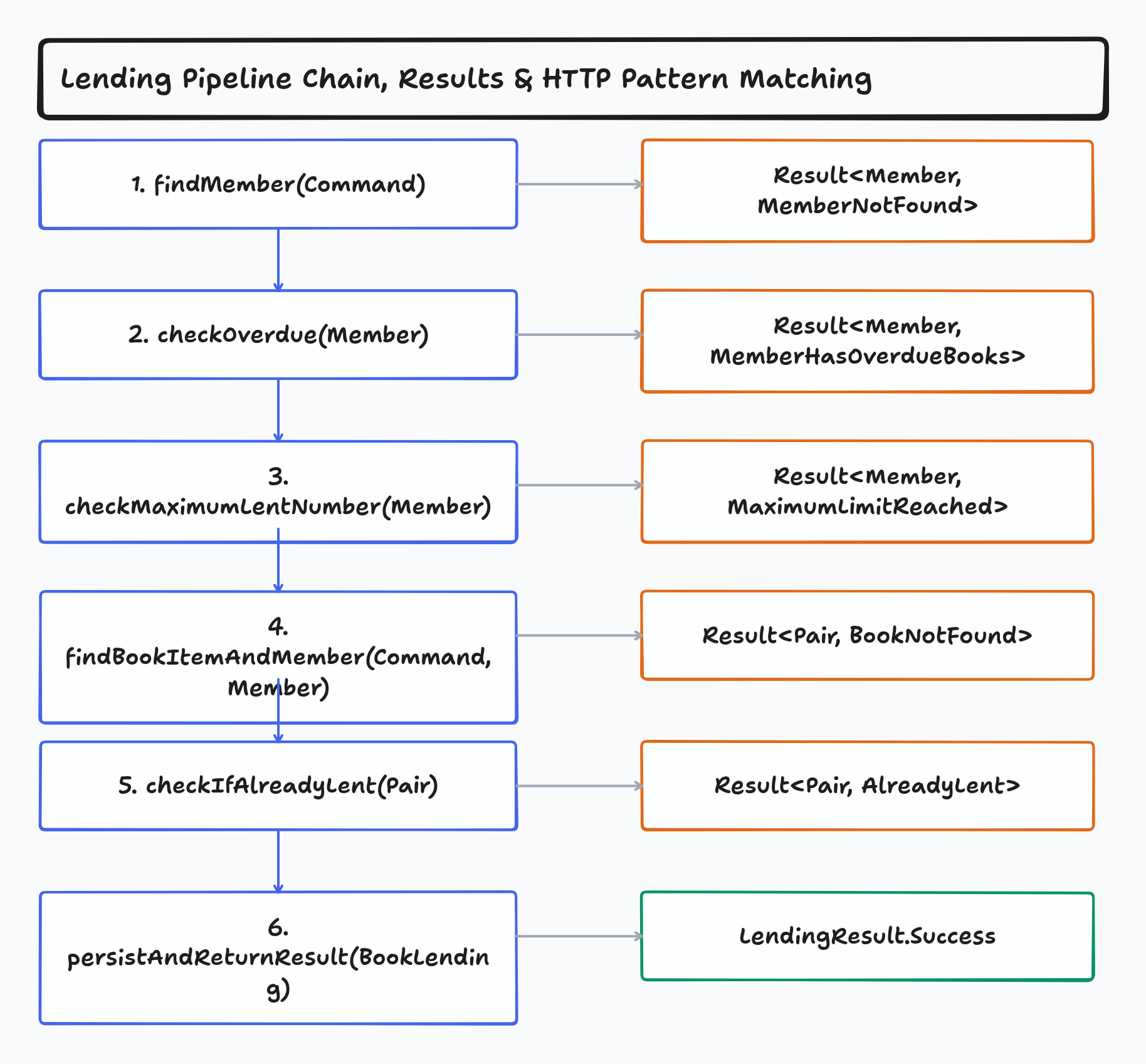
This is how we can compose multiple steps in the LendingService to form a complete railway:
@Transactional
public LendingResult lend(LendCommand lendCommand) {
    return findMember(lendCommand)
            .flatMap(this::checkOverdue)
            .flatMap(this::checkMaximumLentNumber)
            .flatMap(m -> findBookItemAndMember(lendCommand, m))
            .flatMap(this::checkIfAlreadyLent)
            .fold(err -> err, this::persistAndReturnResult);
}
Here, each step returns a Result (or Either). If any step fails, the computation immediately switches to the “error track” (Left / Err), bypassing all subsequent steps. If all steps succeed, it executes the final success track (Right / Ok), persisting the lending and returning the success outcome.
Evaluating Every Possibility: The REST Controller Layer
The functional pipeline completes its journey at the API boundary. By utilizing Java 21’s powerful sealed interface pattern matching, we can evaluate every possible domain outcome of LendingResult in a single, clean switch expression inside our REST resource/controller:
@POST
public Response register(@Valid LendRequest request) {
    var command = new LendCommand(
        new BookItemId(request.bookId()),
        new MemberId(request.memberId())
    );

    var result = lendingService.lend(command);

    return switch (result) {
        case LendingResult.Success(var detail) ->
            Response.ok(detail).build();

        case LendingResult.AlreadyLent(var detail) ->
            Response.status(409).entity(new ErrorResponse("Book already lent")).build();

        case LendingResult.MemberNotFound(var id) ->
            Response.status(404).entity(new ErrorResponse("Member not found: " + id.value())).build();

        case LendingResult.BookNotFound(var id) ->
            Response.status(404).entity(new ErrorResponse("Book item not found: " + id)).build();

        case LendingResult.MemberHasOverdueBooks(var id, var books) ->
            Response.status(403).entity(new ErrorResponse("Member has overdue books")).build();

        case LendingResult.MaximumLimitReached(var id) ->
            Response.status(403).entity(new ErrorResponse("Maximum lending limit reached")).build();
    };
}
Here is a visual breakdown of how the sealed interface record pattern matching deconstructs options and routes them directly to HTTP statuses:
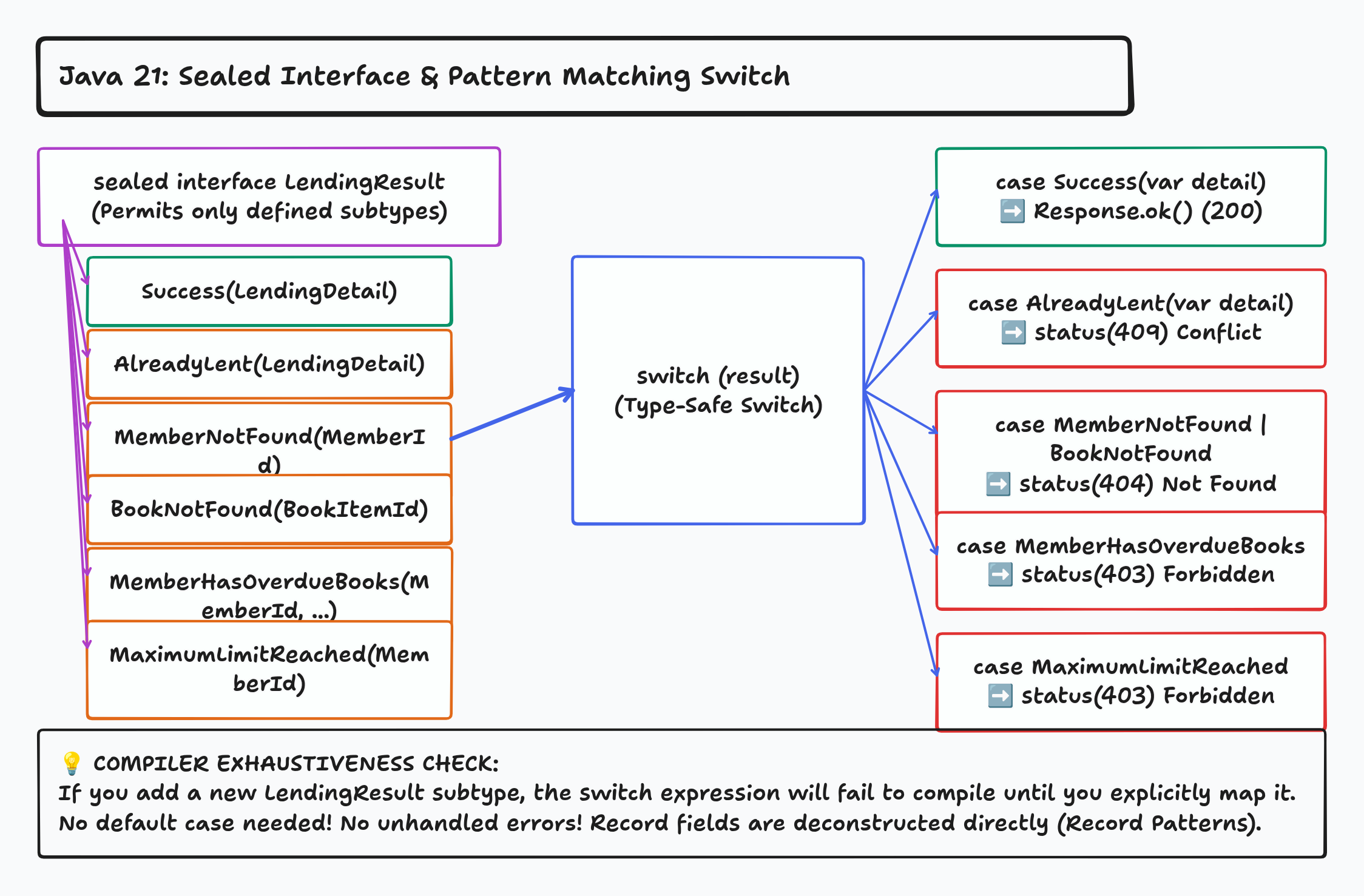
Why is this so powerful?
- Exhaustiveness Guarantee: Because
LendingResultis a sealed hierarchy, the compiler forces us to handle every single scenario. If we add a new business rule (e.g.,MemberIsSuspended), the code will not compile until we explicitly handle that error in our resource layer. No more forgotten exception handlers or untyped internal server errors! - Readability: The entire business flow is mapped to standard REST responses (
200 OK,409 Conflict,404 Not Found,403 Forbidden) in a clean, tabular structure that reads like a specification document. - No Side Effects: There are no hidden exceptions being thrown or caught. Everything is a pure, predictable flow of data from the database query down to the HTTP status code.
Conclusion
By bringing Railway Oriented Programming concepts to Java 21, we can build robust, highly readable, and compile-time safe business pipelines. Combined with sealed interfaces, record patterns, and exhaustive switch expressions, Java has truly evolved into a modern language that supports elegant functional architectures.
If you want to dive deeper, check out the complete implementation in the GitHub Repository.